Check Your Head: Endless Love

(Check Your Head is a new feature in which I write about movies that address mental illness to extremely varying degrees of success. Full disclosure: this is also preliminary promotion for the book I've been working on for the past two years)
Book-to-film adaptations usually fall into one of four categories:
(1) Generally faithful but leaving out certain elements (Jaws omitting the mafia subplot and the grotesque sex scene between Matt Hooper and Ellen Brody, The Godfather not mentioning Sonny Corleone's enormous penis)
(2) So faithful it's as if the screenwriter had the book open on his or her lap while writing the script (a rarity, but No Country for Old Men is at the top of the list)
(3) Condensing thousands of pages of text into 90 minutes of movie (Ron Howard's ill-advised adaptation of Stephen King's expansive Dark Tower series, which covered about 5% of what happens in it)
(4) An adaptation in name only, almost going out of its way to not resemble its source material in any measurable way.
The most obvious example of this is The Lawnmower Man, which bears only two similarities to Stephen King's short story: a lawnmower and a man. However, an underrated contender is 1981's Endless Love, Franco Zeffirelli's syrupy adaptation of Scott Spencer's harrowing novel that turned a story of psychotic obsession into a bittersweet, touching romance.
Though it was a hit at the time, Endless Love is mostly remembered today for its theme song by Diana Ross and Lionel Richie, a wedding reception and prom staple throughout most of the 80s. On a more ominous note, it's also a remnant of the sickening treatment Brooke Shields experienced from the media as a young actress, for which no amount of apologies is enough.
Following 1980's The Blue Lagoon, Endless Love was the second movie in which Shields, just 15 at the time, played a character exploring her sexuality, which was reported on with titillation rather than concern. Shields, after playing a child sex worker in 1978's Pretty Baby, had already been regularly referred to as a "Lolita" and a "nymphet," who turned adult men to slobbering mush. Indeed, People ran a puff piece in advance of the release of Endless Love that featured her leading man, Martin Hewitt (seven years her senior), admitting that he had fallen in love with her and was disappointed that their onscreen romance didn't carry over into real life. Later that year, People ran another puff piece on an entirely manufactured-by-publicists romance between a still-underage Shields and John Travolta (more than a decade her senior), in which Travolta praised her for her "purity."
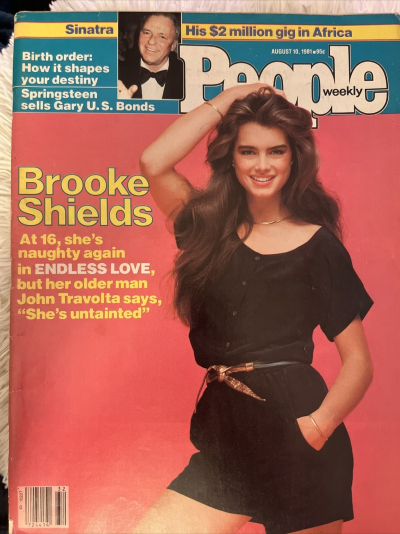
Once Shields turned 18 and entered college, media coverage became mocking instead of salacious, focusing on her shaky acting abilities and alleged stupidity (though considering she graduated from Princeton she was probably smarter than the average New York Post reporter), but also speculating on when and to whom she'd lose her famous virginity. Long after she lost her virginity (to Dean Cain, allegedly), married, and had children, Shields found herself yet again the target of unwanted and inappropriate media attention, after Tom Cruise criticized her in an interview for relying on prescription medication instead of getting a Scientology audit to treat postpartum depression. Shields, who turned 60 last year, has since been criticized for aging naturally without the assistance of plastic surgery, because we're all dead, and social media is Hell.
ANYWAY, I'm getting off track. Initially, Endless Love seems like a standard, contemporary take on Romeo & Juliet about David (Hewitt) and Jade (Shields), two personality-free teenagers who fall in love despite their very different backgrounds. David is the only child of stodgy academic parents, while Jade is the middle child in a free-spirited hippie family (which includes older brother James Spader, in only his second feature film). Though David is warmly welcomed into Jade's boisterous, unconventional household, the intensity of their relationship (which causes Jade to lose sleep and neglect her grades) begins to alarm everyone around them.
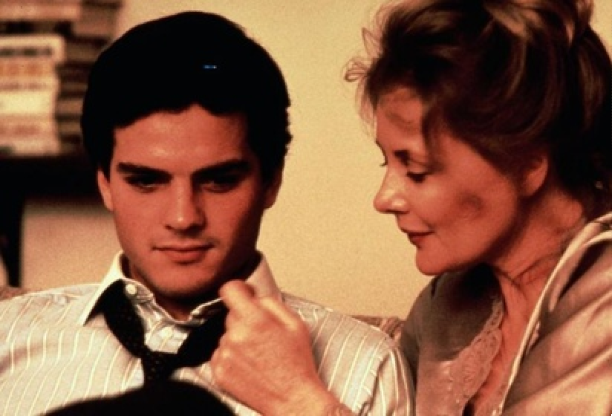
Everyone, that is, except Jade's mother Ann (Shirley Knight), and here's where things get weird. Ann is thrilled that her 15 year-old daughter is regularly having sex (even spying on the young lovers in one spine-crawling scene), and heavily implies that if she were 30 years younger she'd be trying to get David into the sack too (and, in fact, she does come on to him later in the film, after a few years have passed). Thankfully, Jade's father, Hugh (Don Murray), is the rational parent in the household, and, after Jade is caught stealing prescription medication to deal with the lack of sleep from having sex with her boyfriend every night, demands that she and David break up.
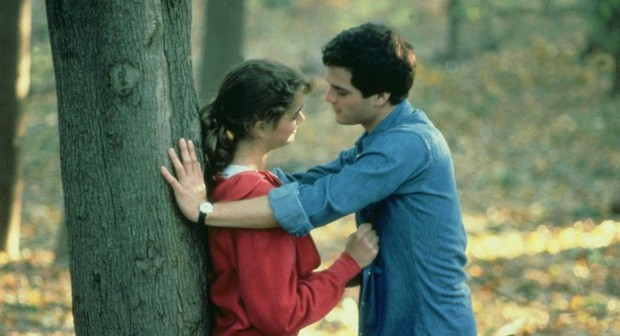
David is distraught over the end of the relationship, and, inspired by a story of childhood arson committed by a high school buddy (played by Tom Cruise with his charming original teeth), he decides to win Jade back by setting her house on fire. No, wait, hear me out, it's a solid plan: by rescuing everyone from the fire he started, he'll be a hero, and Jade's family will have no choice but to allow them to start dating again. Unbelievably, this genius idea doesn't work, Jade's house burns down, and David is immediately caught.
To put a long story short, a few years in a psychiatric hospital and a restraining order don't cool David's ardor a bit, and very nearly the first thing he does upon release is track Jade down at college. Before he can find her there, however, he runs into Hugh, understandably still pissed off about the whole burning his house down. Hugh chases after David, but is hit by a car and killed. So, let's add "got dad killed" to "burned house down" to the list of reasons Jade shouldn't get back together with David, followed later by "physically restrained her until she admitted she still loves him too."
If you've never seen Endless Love, you might think this is a suspense thriller that will likely end with either David or Jade or both stabbed to death. Haaaang on. After all this, Jade, despite telling David they can never be together, admits to her mother that no one will ever love her the way David did, and she still wants to be with him. Ann (who, let's reiterate, also finds David inexplicably irresistible) gives her blessing, as if to suggest that she was young once, and had boyfriends who burned her house down and got her dad killed. Hey, love makes you do crazy things, amirite?
Anyway, the movie ends with Jade visiting David in jail, heavily suggesting that they're going to reconcile, and the opening bars of that iconic theme song.
Many have written about the disturbing trend of movies (particularly romantic comedies) in which toxic (occasionally even dangerous) behavior is framed as a grand gesture of love. Whether it's gaslighting, misrepresenting oneself, sabotage, or good old-fashioned stalking, the audience is meant to come away thinking that it's all worth it to be with the one you love. I'm pretty sure the audience of Endless Love was meant to wistfully sigh in relief that these two star-crossed lovers, despite one of them exhibiting violently unstable behavior that's already resulted in one accidental death, will be together after all.
The way things play out, David seems like a perfectly normal (if not kind of boring, which makes both Jade and Ann's infatuation with him puzzling at best) guy, who only snaps after Hugh tells him he can't see Jade anymore. So, really, much of what ensues is Hugh's fault for being a tight-ass who doesn't recognize twoo wuv even when it's blossoming in his own home. Well, joke's on you, old man, you're dead and David and Jade are working things out, so all your "fatherly concern" turned out to be for nothing.
It's a wild interpretation of Spencer's novel, which I was appalled by as a teenager, then re-read as an adult and appreciated far more once I understood what Spencer was doing. An underrated example of the unreliable narrator, the story is told entirely from David's viewpoint, and opens with his setting fire to Jade's house, with the rest of the narrative out of sequence. It's immediately apparent that David is emotionally disturbed, and has always been disturbed, even before he meets Jade. He's alternately guilt-ridden, self-pitying, and defiant about what his all-consuming love for Jade has made him do, aware that it's wrong but unable (and unwilling) to stop himself. The reader is meant to find him unsettling as opposed to sympathetic, as with the film version of David.
Because David is an unreliable narrator (and, to quote my late father, crazier than a shithouse rat), it's impossible to know how much of what takes place in the novel is real or a delusion on his part. We never know if Jade really does reciprocate his love at the same level of intensity, or if at all. It's chilling to consider that there may have never even been a relationship with Jade in the first place, he simply latched onto her as a target of romantic obsession. Despite taking place over a decade, with David in and out of psychiatric treatment, he's no better by the end of the novel, as it concludes with a dramatic, ominous declaration that he hasn't and will never let Jade go. It's an ending that sticks with you far more than a touching reunion set to a love song.
While Franco Zeffirelli directed a pretty bad adaptation of Endless Love, woefully misunderstanding the point that there's no coming back from an obsessive love so destructive it literally results in death, he didn't direct the worst adaptation of Endless Love. No, that dishonor goes to Shana Feste, whose 2014 version doesn't play in ambiguities, portraying David as the romantic hero whose relationship with Jade is sabotaged by a cruel and manipulative Hugh, not because they're too young (the script conveniently ages them up to college), but just because he doesn't like David.
The only fire that happens is accidentally caused by Hugh, no one's house burns down, no one spends time in a psychiatric hospital, and no one gets hit by a car and dies. It ends on a happy note, with David and Jade together and Jade declaring that true love is worth fighting for. In a period of limp romantic dramas meant to appeal to fans of Nicholas Sparks, the second adaptation of Endless Love might be among the limpest, a remarkable accomplishment considering it's based on a book narrated by a mentally ill young man who, if he hasn't killed someone already, seems like he's about to.

Comments ()